
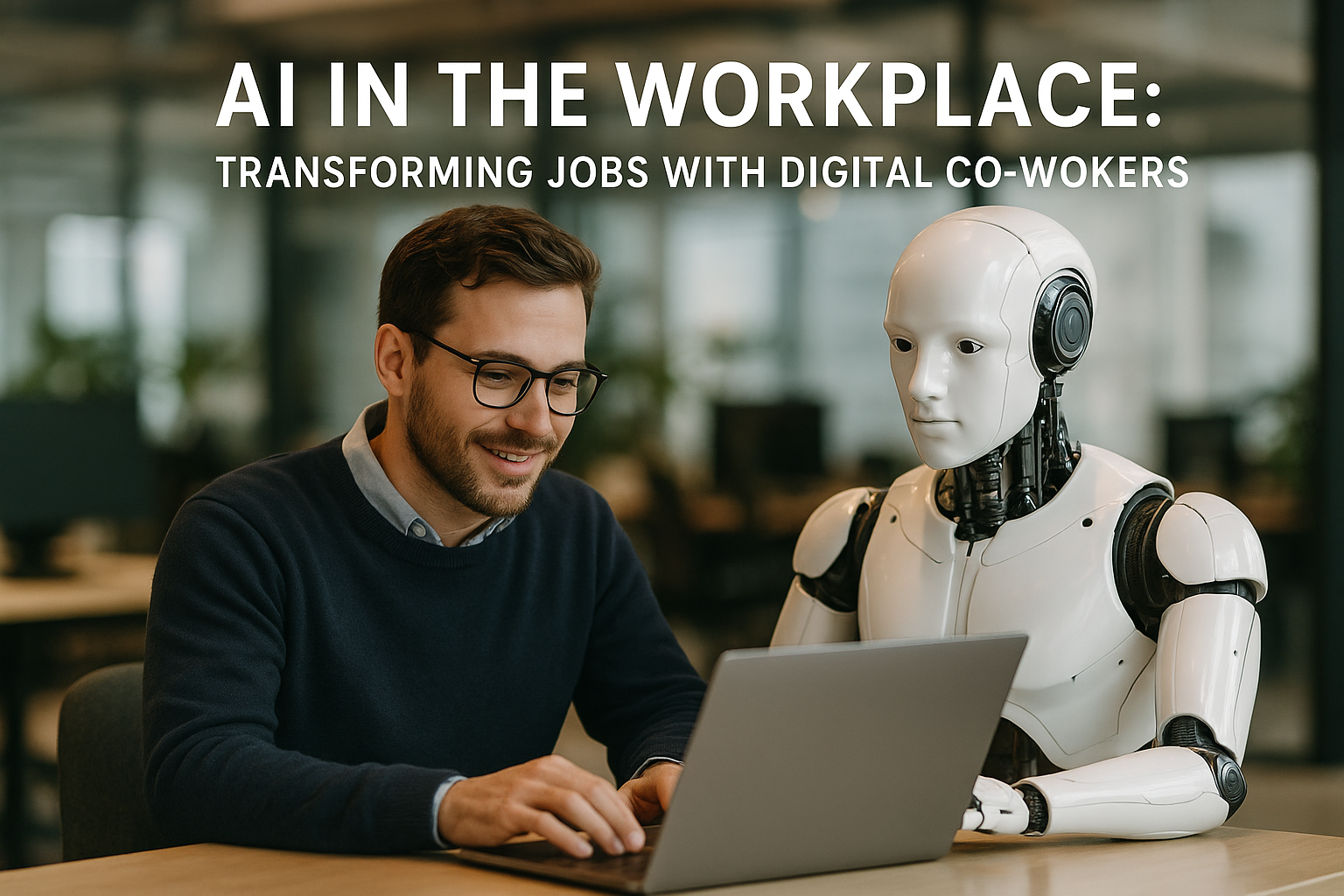
The workplace isn’t just evolving—it’s forging a new partnership. Artificial intelligence has shifted from experimental tech to an essential colleague, redefining productivity, creativity, and the DNA of work itself. With a significant majority of companies now weaving AI into core operations, professionals fluent in this collaboration hold a decisive edge. Here’s how the revolution unfolds:
1. Beyond Automation: The “Superagency” Era
AI’s power lies in amplifying human potential, not replacing it. This synergy creates:
AI handling cognitive load: Crunching data, predicting trends, automating routines.
Humans focusing on judgment: Applying ethics, emotional intelligence, and strategic context.
Forward-thinking organizations now train teams to leverage AI for ideation, research, and drafting—freeing up to 30% of their time for creative problem-solving.
2. AI Agents: Your Silent Productivity Partners
2025’s game-changer is the rise of autonomous AI agents that execute multi-step tasks:
| Agent Type | Role | Impact |
|---|---|---|
| Specialist Agents | Manage repetitive tasks | Resume screening, interview scheduling |
| Co-Worker Agents | Brainstorm & co-create | Simulating product launches, optimizing workflows |
| Supervisor Agents | Orchestrate other AI | Real-time logistics management |
These agents are already optimizing manufacturing, reducing downtime, and reshaping roles across industries.
3. The Human Edge: Where AI Still Needs Us
Despite advances, AI lacks irreplaceable human strengths:
Ethical discernment (e.g., medical decisions requiring patient context).
Emotional intelligence (e.g., preserving customer trust during conflict).
Bias mitigation (proven failures in early AI hiring tools).
Leading companies now design workflows with “humans in control, AI in the loop”—ensuring transparency and accountability.
4. The Skills Revolution: Learning the AI Dance
With nearly half of workforce skills facing AI disruption, professionals must:
Master collaborative intelligence: Orchestrating AI while applying critical thinking.
Develop AI literacy: Prompt engineering and output validation.
Hone irreplaceable skills: Creativity, empathy, complex problem-solving.
Companies investing in reskilling see remarkable results—like customer service teams evolving into AI-augmented consultants, unlocking new revenue streams.
5. Navigating the AI Regulatory Landscape
New laws are emerging to govern workplace AI, including:
Mandatory bias audits for hiring tools.
Bans on AI-enabled discrimination.
Risk assessments for “high-risk” AI decisions.
These regulations cement human oversight as a legal imperative—not just a best practice.
6. Bridging the Trust Gap
Employee apprehension about AI persists, particularly among underrepresented groups. Building confidence requires:
Radical transparency: Demystifying how AI tools work.
Inclusive training: Tailored upskilling for all roles.
Co-creation: Involving teams in designing AI workflows.
“The best outcomes emerge when AI guides and humans decide.”
The Path Forward: Redefining Work’s Social Contract
The most competitive organizations treat human-AI collaboration as a leadership challenge, not just a tech upgrade. They:
Redesign roles around augmentation, not just automation.
Invest in continuous learning to close skills gaps.
Balance efficiency with humanity (e.g., AI prompting breaks during intense work).
The future belongs to those who see AI as a partner in innovation. In Industry 5.0’s human-centric era, our greatest advantage remains: the human spark, amplified by machine intelligence.
How are you adapting to human-AI collaboration? Share your journey below.